How Complete Does Your Artwork Need to Be for Custom Enamel Pins?
Table of Contents


If you're a designer, independent creator, or collector looking to make custom enamel pins or challenge coins, you may be wondering how complete your artwork needs to be before submitting it for production.
This article will help you quickly understand the basics in just two minutes.
If all you have is a sketch or reference image, don't worry. Most artwork can be prepared for production with just a few adjustments.
Common Misunderstandings and Their Impact
Some customers think they can simply send a picture, such as a reference image or a rough sketch, and have it turned into a custom enamel pin. However, manufacturing custom pins is often a detailed and precise process. If your artwork is not fully prepared, it may require additional revisions, increase communication time, affect the production schedule, and even impact the final product quality.
If you want the finished product to match your original design as closely as possible, make sure you prepare the following three points in advance.
I. Control Line Thickness and Color Block Size
First, pay attention to the thickness of your lines and the size of each color area.
To avoid blurry details or broken metal lines in the finished product, we recommend that line thickness be at least 0.1 mm, and each individual color area be no smaller than 0.3 mm.
We understand that many people want to include rich details in their artwork. However, areas that are too small cannot be properly filled with enamel, and the finished result may be almost invisible to the naked eye. There's no need to keep these tiny details if they won't be visible in the final product.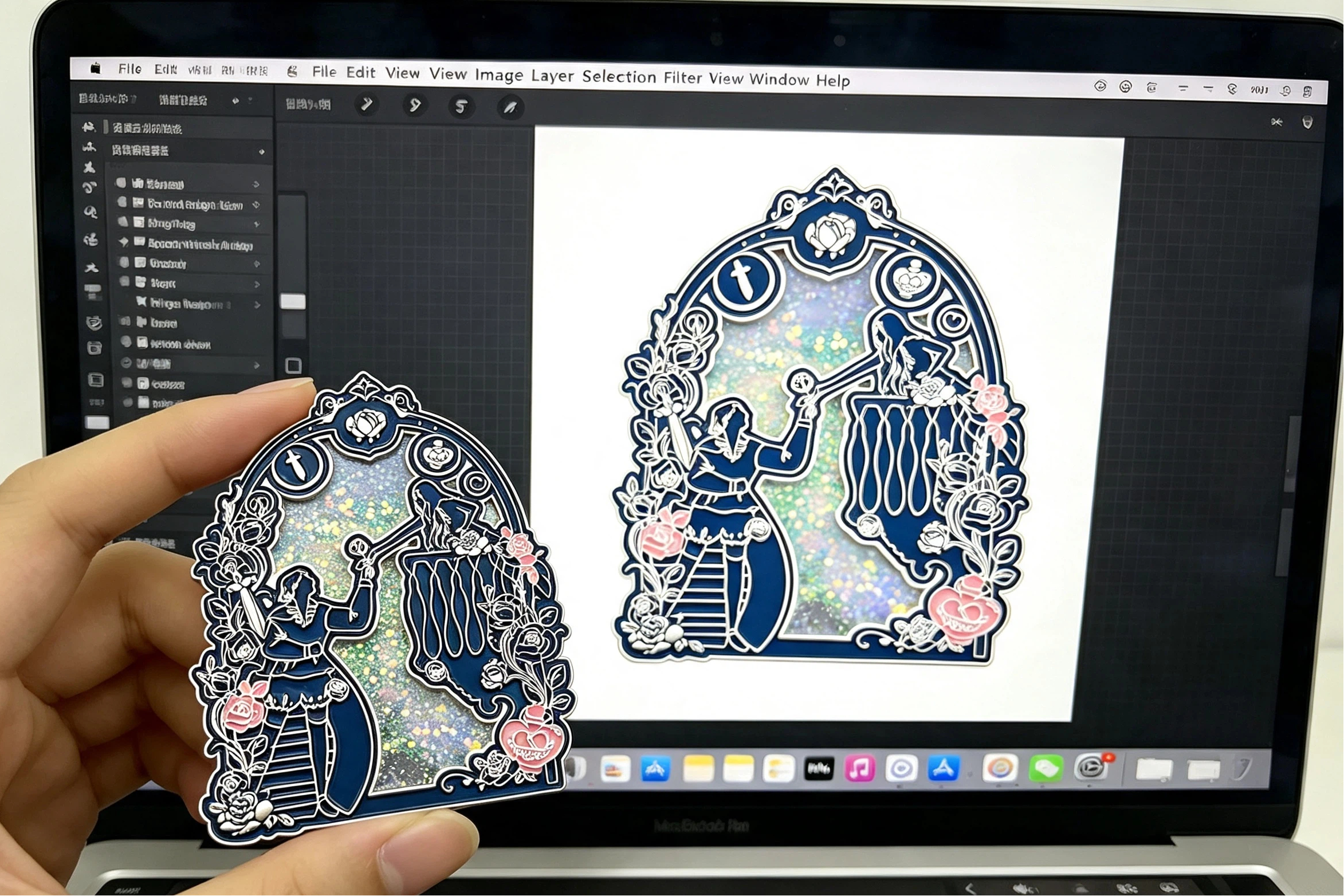
II. Colors and Production Process
Next, consider your colors and production process.
Maxemblem typically uses the Pantone Matching System (Pantone C) for color matching. If your artwork includes Pantone color codes, it can minimize color differences during production.
As for the production process, if you've already decided to use hard enamel, soft enamel, or a 3D effect, be sure to let the manufacturer know when submitting your artwork. This can help reduce later revisions.
Once you've decided on the special effect you want, the manufacturer can more accurately determine the production process, reduce unnecessary revisions, and improve production efficiency.
If you'd like to learn more about enamel pin manufacturing processes, you can read: Custom Enamel Pin Manufacturing Processes.
III. Image Quality
Finally, make sure your artwork is saved in the correct format.
Once your design is finalized, always keep the original source file. The recommended file formats are AI, EPS, or vector PDF. If you don't have a vector file, we recommend providing a high-resolution PNG or PSD file instead.
High-quality source files ensure that details remain sharp when enlarged, resulting in cleaner lines and a more refined finished product.
The three points above apply to most standard projects. However, if your design includes special finishes such as glitter enamel, combines multiple production techniques such as a double-sided 3D enamel pin, or if your product size falls outside the standard 0.75–1.5 inch range, we recommend discussing your project directly with the manufacturer. They usually have extensive experience and can help you choose the most suitable production method.
If you don't yet have a complete design, some manufacturers, such as Maxemblem, can also provide free design and revision services. Clear communication at the beginning can save you unnecessary work later and help create the best possible final product.
(For common enamel pin sizes and illustrations, please refer to: How to Choose the Right Size for Custom Enamel Pins?)
Conclusion
In short, following these three points is the foundation for turning your artwork into a successful custom product.
If you've already decided on the size, colors, and general production process, even if your artwork is still just a sketch, you can send it to the manufacturer for evaluation.
Do you have a design you'd like to customize?
Feel free to send your artwork—or any of your ideas—to [[email protected]](mailto:[email protected]). If you're not sure whether your artwork is suitable for production, we'll be happy to review it for free and provide professional suggestions.